 Gilles Crofils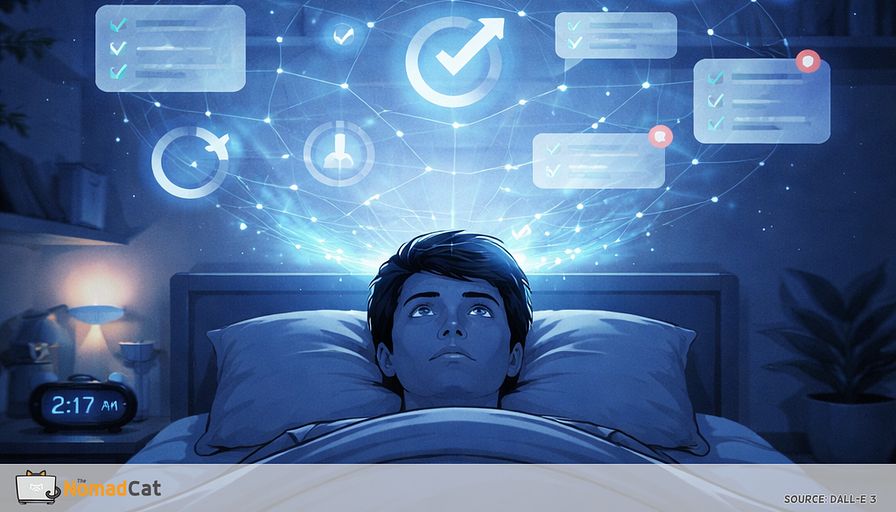
You do a normal 10-hour desk day. Meetings, tabs, maybe a late message you should not answer but you answer anyway. You fall asleep fine. And then somewhere around 02:17, your eyes open like someone flipped a switch. Not groggy. Not confused. Just… online. Brain sharp. A little too ready to plan, check, fix, review.
If that sounds familiar, this article puts a name on it. The two alarm night. Not as a personality flaw or “bad discipline”, but as a sleep pattern where the nervous system keeps running status checks in the middle of the night. Once the brain learns that waking up leads to certainty or problem solving, it can turn into a loop.
The goal here is simple. Make the wakeups less frequent. And when they happen, keep them boring enough that they don’t expand into a 45-minute work session.
What you will get in the next sections
- A quick checklist to recognize the sharp 01:30 to 03:30 wake, and a clear boundary for when it might be a different issue
- Why the second half of the night is the easiest place for this clean reboot to trigger
- The desk-work drivers that keep the brain cached on unfinished queues, especially reopenable work and unclear urgency
- A minimal 02:00 protocol designed to remove the reward, not to win sleep by force
- One daytime closure lever that reduces nighttime polling, using simple ownership and escalation logic
- A small 3-night test with zero apps, plus guardrails for when it’s time to get checked instead of tweaking habits
No heroics. No perfect evenings. Just a few configuration changes that fit inside real workdays, even for a metrics-minded brain that would prefer another dashboard.
The two alarm night signature
A checklist that feels annoyingly specific
Then somewhere between 01:30 and 03:30, you wake up like a laptop that just rebooted. Eyes open, brain sharp. Heart a bit faster. It feels less like panic and more like capacity, with a weird “time to handle something” vibe.
A useful label for this is the two alarm night. Quick check if it sounds like you
- Sleep onset is mostly fine
- Between 01:30 and 03:30 there is a sudden clean wake, not a slow drift
- First urge is to plan, check, fix, or mentally review work and life queues
- You often fall back asleep, but the rest of the night feels thinner
- The odd part is the speed of mental readiness
Brief awakenings are common in normal sleep. And 1 bad night proves almost nothing.
This pattern is often misfiled as “bad discipline”. Not a moral failure. More like a sleep continuity issue where the nervous system keeps doing status checks mid-sleep. Some insomnia models describe this “too ready” state, and once the brain starts monitoring the wake, it can keep the loop going.
One clean boundary. If awakenings are groggy, confused, heavy, or you stay awake for long stretches in distress, that can be a different problem. This article targets the sharp mini-startle wake where you feel oddly competent at 02:17.
Why the second half of the night gets you
Sleep is naturally lighter later in the night. So the wake threshold drops. If the system is already in monitoring mode, small internal cues can trigger a clean alert spike. That puts 01:30 to 03:30 in the classic reboot zone.
It also explains why focusing only on screens can miss the driver. A vigilant system runs checks when the room is quiet and the traffic is low. People who are on-call often sleep worse on on-call nights even if the phone never rings, because the brain stays in “might be needed” mode.
Screens can still matter. Light-emitting devices can shift alertness under controlled conditions. But plenty of people with fairly clean evenings still get the sharp 02:17 wake. That points upstream.
Reopenable desk work and the false alarm wake
Work that never really ships
Reopenability is simple. The work is “done” until 1 comment lands and the ticket is back in your queue. So it never fully leaves memory. It stays cached after shutdown.
Reopenability gets worse when urgency rules are unclear.
Unclear urgency is not the same as high workload. A predictable 10-hour day can still allow the system to power down. The problem is the maybe-urgent, where there is no clean escalation lane and everything might be your problem at 02:00. Uncertainty keeps anticipatory responding switched on.
And then there is the social layer. A short “can you look?” message with no deadline. A public thread where everyone can see who answered and who did not, plus that little “?” reaction sitting there like a timer. Put this together and the night wake starts to look like a predictable perimeter scan.
3 desk triggers that teach the brain to poll at night
Trigger 1 is unassigned ownership. When nobody clearly owns the failure, your brain does.
Trigger 2 is silent waiting. You are blocked on someone else. Suspense acts like a real load, even if you’re “not doing anything”.
Trigger 3 is tomorrow churn. If mornings are known to reshuffle, early monitoring can become “useful insurance” and then a trained check.
Naming what is happening matters because it points upstream. It is often easier to adjust escalation, ownership, and detachment conditions than to argue with yourself at 02:17.
The 02 00 protocol that stays boring
Do not reward the wakeup
The goal is not heroic instant sleep. The win is preventing a 90-second reboot from turning into a 45-minute mental work session. That creates a feedback loop. This is basically stimulus control: don’t teach your brain that bed = planning.
So remove the reward the brain is chasing at night.
No certainty-seeking. No phone, calendar, Slack, email, or even time-checking. If checking reduces uncertainty once, the brain learns that waking up is useful.
If you truly need to capture a thought, do it in the least interesting way possible.
Write 1 bounded line, then stop. Not planning, just offloading.
If thinking about X, tomorrow at Y I do Z.
A runbook for the mini startle
When the wake is sharp, a dry script beats improvisation.
1) Label it a false alarm wake. Yes, it sounds silly. It works better than arguing at 02:17.
2) If needed, do the 1-line paper capture
3) Do 1 downshift cue, then back down
Keep the downshift cue minimal so it does not become a ritual. Options include sitting up for 10 to 20 seconds, or a sip of water only if truly thirsty.
If you are still fully online after roughly 15 to 20 minutes, stimulus control is the boring fix. Get out of bed in dim light, do a quiet activity, return only when sleepy.
What not to do
- No problem-solving posture
- No inbox triage
- No “since I’m awake” planning
- No rehearsing conversations
Complexity is a hidden reward. Elaborate protocols can turn into sleep effort, which tends to maintain the monitoring loop.
One daytime closure lever that reduces false alarms
Make 1 thing non reopenable before dinner
Uncertainty carried into evening tends to grow teeth. Non reopenable does not mean perfect. It means defensible enough that your brain stops keeping it cached.
It includes
- a clear current truth plus the next touch time
- a clear reopen trigger so “not now” is not “never”
Before dinner matters because it blocks low-grade monitoring from taking over the evening.
A 60-second template keeps it small enough to survive real days. Treat it like a tiny closure packet.
- What is true now
- What is not happening tonight
- Next touch time on the calendar
- Owner if it is not you
- Reopen trigger that makes it actionable again
This is basically an internal alert rule. The plain-language version: decide what counts as an emergency, decide who owns it, and write down the next touch time so your brain doesn’t keep pinging you “just in case” at 02:00.
A metrics brain still needs boring sleep
I’m french, born in 1974. Physics trained. I’ve done the Beijing → Berlin → Lisbon desk years, so my reflex is always: measure it. More charts, more HRV, more sleep scores, more “maybe this explains it”. But this 02:00 sharp wake pattern often improves with boring configuration changes, not more monitoring.
A 3 night test with zero apps
Night 1 is baseline. If the wake happens, do nothing new. In the morning only, answer 2 questions in a notebook.
- Did it feel like a startle reboot or a slow drift awake
- What was the first impulse check plan fix
Then run 2 nights where both levers are applied.
On nights 2 and 3
- Use the boring 02:00 protocol if the wake hits
- During the day, make 1 deliverable non reopenable before dinner
Keep measurement equally small.
Expect variability. Brief awakenings are common. 3 nights will not prove small effects. But big behavior differences show up fast.
Guardrails for when it is not just desk work
Earlier I said: this is the sharp, competent wake. Here is when it’s probably not that, or when it’s time to stop tweaking and get checked.
Not every 02:00 reboot is a work loop. Sometimes it is a breathing problem that needs screening. Red flags often used in OSA guidance include
- loud frequent snoring
- choking or gasping at night
- witnessed breathing pauses
- severe daytime sleepiness
- dozing while driving or near-miss episodes
A wake with adrenaline can also come from things that push stress hormones up or interrupt breathing in small bursts—reflux, thyroid overactivity, panic, hypoglycemia risk, or heart rhythm issues. If it keeps repeating, treat it as “needs a check”, not “proof of weak discipline”.
When sleep maintenance problems persist for weeks and impair daytime functioning, the next step with the best track record is structured CBT‑I, not adding 7 more rules.
Success here is modest and realistic. Fewer clean 02:00 competent reboots. Less certainty-seeking when they happen. Same systems framing. Change alert rules and closure conditions, not personality.
After a 10-hour desk day, the 02:17 wake can feel like a personal bug. But the “two alarm night” frame makes it simpler: a sleep continuity loop where a vigilant brain runs status checks.
Later-night sleep is lighter, so the reboot triggers easier, especially when work stays reopenable, urgency is fuzzy, and ownership is unclear. The practical tell is the first impulse: if it’s “check / fix / review,” treat it as a false alarm wake. Keep it boring—no inbox, no clock, no problem-solving posture. If needed, capture 1 dry line on paper and stop, then use a minimal downshift cue, or stimulus control if you are fully online.
Daytime closure helps too. Make 1 thing non reopenable before dinner, with an owner and next touch time. Most of the time it’s not your discipline. It’s your alert rules leaking into bed.


