Explore.Commit.Repeat.
AI gave every company the same superpower: try anything, this week. Keeping that freedom gets harder when customers pay for your features, trust you with their data, and build their operations around your systems.
I explore with you, and I'm accountable for the technology behind everything we commit to. Your 1,000th customer should never put your next experiment on hold.
1974 Birth.
1984 Delved into coding.
1999 Failed my first startup in science popularization.
2010 Became CTO of a digital agency in Beijing.
2017 Turned a bootstrapped Berlin startup's MVP into a scalable platform.
2026 Shut down my AI coaching startup after 2 years. I could build it. I couldn't sell it.
I landed in Beijing at the university, with a physics education and no business training. A year later I joined the French Chamber of Commerce, by chance, which is how things happened in China then. The team was small and lightly managed, so I did whatever needed doing: training sessions for expatriates, budgets for new projects, and a Linux server for the office that nobody had asked me to build.
Popsciences was my own project: a sort of wikipedia for science, open to everyone, with contributions approved by researchers from my network at the CNRS. I worked on it for about a year, mostly on paper. In my spreadsheet I was a billionaire. In real life I never raised a penny and never earned one. Since then I tell every entrepreneur the same thing: don't write a business model. You'll believe it.
Summer 2001, back in Paris with nothing raised. A friend from Beijing introduced me to Unilog. IT services firms were hiring anyone at the time, and they hired me. The day my first salary arrived, I realized that someone was paying me for what I had been doing since I was 10. Almost 10 years followed, at Unilog and then Micropole, on web and business intelligence projects for banks and insurers, some with 100 people on them. At Generali I managed a team as the only external manager among about 10.
Second Bureau took me back to China as CTO and Managing Director Asia, at a digital agency. I hired and trained the engineers in Rails and shipped the client projects, while also selling and running the company with my partner.
Web agencies in Beijing then renewed their staff every few months. People were cheap, and redoing work was fine. We paid our engineers well so they would stay. We grew to about 15 people between Beijing and Paris, and in 3 years 1 person left.
In 2013 the cash was running out, and we wound the company down before we could no longer pay salaries. I spent the last weeks talking honestly with the team about what came next. It was the toughest part of those years.
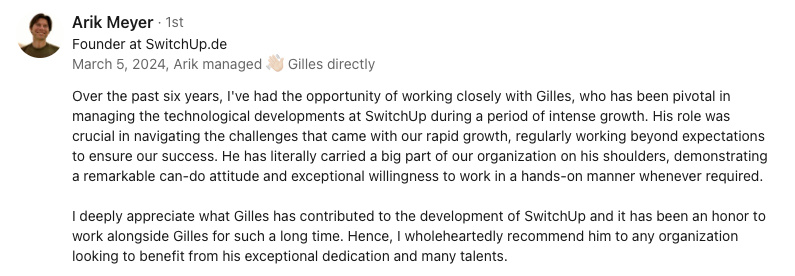
SwitchUp was a bootstrapped startup in Berlin whose first version had outgrown itself. I joined as Hands-On CTO, and for 6 years my job was to turn it into a platform that could carry the business, one piece at a time, while the old one kept serving customers. The work was architecture, a roadmap, hiring in Berlin and remotely, and managing an outsourced engineering partner. Every day I chose between what to fix now and what to build properly, with no rule to lean on.
By the time I left, the platform followed the energy contracts of hundreds of thousands of customers, up from tens of thousands, and the business ran on it.
After SwitchUp I worked full time on AI, with no client and no deadline. It became Nook, a health coach that remembers you. It was a business, meant to earn, and it took 2 years.
The hard problem was memory. A coach has to remember a client across weeks without forgetting what mattered or inventing what didn't, so I built several kinds, from standing preferences to a narrative that slowly fades. I spent more than a year testing them against real conversations. For one of them, most of what the model extracted was noise.
What I never found was the sentence that told a visitor why Nook was different from any other AI chat. The difference lived in machinery that, by design, nobody could see. I shut it down in 2026.
In the early 2000s, a ready-to-wear label I co-founded with a Chinese designer, made in Beijing and Shanghai and sold in shops across Western Europe; I did the import and export accounting myself. Since 2009, my family's rental properties; I wrote a small Rails app to run them, and I still maintain it. More recently Klora, which runs a family property company without a spreadsheet; Squirrel, a budget for people who can't take their income for granted; Mechanical Writer, a content pipeline that checks itself for sounding like AI; and Ghostwave, a mystery weekend for 12 friends. Their stories are in Products.