 Gilles Crofils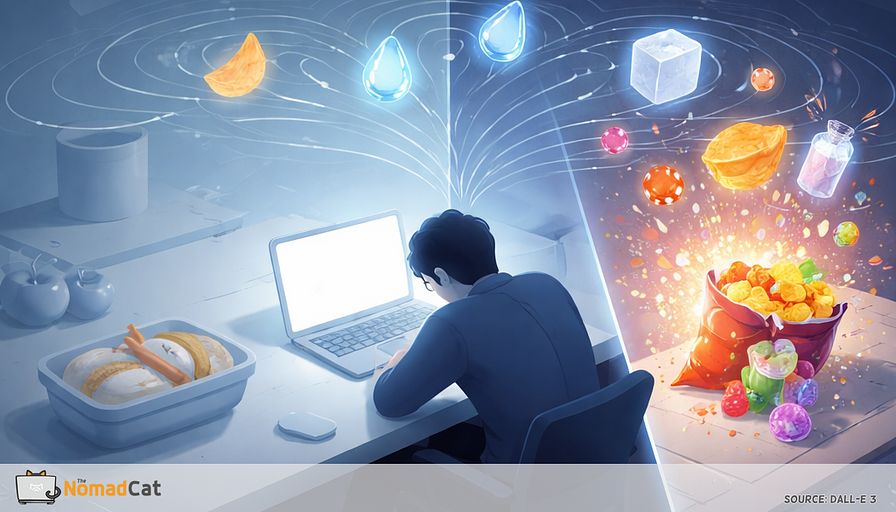
It’s 15:30 and you’re not even properly hungry. Lunch happened, yes. The calendar is still a wall of 30-minute blocks. You’ve been sitting so long your neck feels like a badly folded towel. And somehow the only thought with real energy is “something different.” Not more food, just… colder, crunchier, sweeter, saltier. Anything that breaks the sameness of desk life.
If that sounds familiar, it’s not you “having no discipline.” A lot of desk cravings are less about fuel and more about stimulation. When the day is flat and repetitive, the brain starts scanning for novelty. Food is nearby, socially acceptable, and works fast. So the loop builds itself.
This article is here to make that loop easier to read, without turning it into a personality test or a whole new meal plan. I’m French (born in 1974), and after years of desk days from Beijing to Berlin to Lisbon, I’ve learned to treat the 15:30 thing like a system bug, not a morality play. You’ll get a simple way to tell the difference between:
- real hunger vs “I need a different sensation”
- low energy vs low stimulation
- the normal post-lunch dip vs a snack habit that’s really just boredom in a trench coat
Then it gets practical. You’ll see a quick 20-second “debug” check you can run in the moment, plus a tiny fix that fits inside a chaotic schedule. Keep your usual lunch, add 1 sensory contrast that’s desk-legal (quiet, low-mess, low-odor, pauseable). There’s also a short 5-day log idea if you want data without making it… a whole thing.
No perfection. No dramatic rules. Just a small config change that makes lunch feel like it actually happened, so 15:30 stops acting like a snack emergency.
When your desk makes everything taste the same
The moment it starts
It usually begins with a very specific thought: different. Not “I’m starving,” more like a vague need for a new sensation in your mouth. Cold. Crunch. Salt. Sweet. Something that feels like hitting refresh.
That detail matters. Cravings are often about specific sensory qualities, not just “more calories” (Weingarten & Elston, 1990). Once you notice “different” versus “more,” the loop stops looking like a character flaw.
Palate fatigue, in plain terms, is what happens when your day keeps serving the same narrow band of sensations, so your brain starts scanning for novelty. Desk days make this easy. The environment is flat. The food is often flat too. Repetition becomes the default because it is clean, quick, and meeting-compatible.
This is not a diagnosis and not medical advice. It’s also not the same thing as true hunger.
A useful piece of background: after you eat one type of food, it can start sounding “meh” pretty fast, while different foods still sound appealing. That’s part of why a “different” snack suddenly feels urgent later (Rolls, 1986).
Palate fatigue is a real desk bug
The snack urge that is not really about fuel
A 10-hour desk day has a particular texture. Lunch was fine, even “enough.” But around 15:30 the brain starts running a background search for a small hit of new. Something crisp, cold, loud in the mouth, maybe sticky-sweet, maybe salty. If you’re camera-on and back-to-back, it gets even funnier because the “desk-legal” options are usually the same quiet foods on repeat, and the craving starts targeting exactly what is missing.
A practical way to separate signals without turning it into a personality test is a quick internal log:
- Hunger 0–10
- Craving for a specific thing 0–10
Research often uses simple scales like this (Flint et al., 2000). The number is not the point. The point is noticing when the question is “new texture” rather than “food.”
A feedback loop made of clean lunches and restless brains
Desk days quietly reward repeatability. The same safe meals show up because they are fast, low-mess, and don’t create a cleanup tax between calls.
Then mid-afternoon hits and the system asks for a small reward. Not because you “lack discipline,” but because under-stimulation feels annoying and the mind goes for the easiest fix. Food is available, allowed, and works fast.
The loop looks boring on paper, which is why it works:
- same default lunch
- relief decays
- coffee or snack
- relief decays
- repeat
The simplest tell
If someone offered the exact same lunch again at 15:30, would it sound appealing? Many people feel a flat no, even if they admit they could eat something. But a different texture suddenly sounds perfect.
That pattern matches the “different is still interesting” effect above (Rolls, 1986).
Why desk work makes food boring on purpose
The hidden filter you apply all day
Even when you could eat something more interesting, the social cost makes you self-censor.
Desk work selects for food that is:
- quiet
- one-handed
- low-mess
- pauseable
- camera-safe
So the menu gets filtered toward soft textures, mild aromas, and predictable packaging. Anything crunchy enough to be loud, saucy enough to drip, or aromatic enough to announce itself gets disqualified before nutrition even enters the chat.
Managing impressions also narrows the range. People tend to converge toward what seems acceptable in the situation, even if they’d choose differently alone (Herman, Roth & Polivy, 2003). Video calls reinforce it. Chewing is basically broadcast to 12 people who did not consent.
When meals feel less satisfying, the brain looks for stimulation somewhere else. Food is 30 seconds away. So is scrolling. Smartphone use is often motivated by relief from negative states like boredom, which makes it a parallel option in the same loop (Elhai et al., 2017). The desk isn’t only removing sensory variety, it’s also putting tiny relief buttons within arm’s reach.
When low energy is really low stimulation
Calling it fatigue because it is the closest word
Two things explain why “something different” works so well in the middle of a desk day.
First, the feeling is confusing. It can look like fatigue, but it’s often fidgety fatigue rather than empty-stomach hunger. You’re not thinking “food.” You’re thinking “state change.”
When tasks don’t change for hours, attention slips and your brain starts looking for an easier target—often food (Westgate & Wilson, 2018; Mackworth, 1948).
Second, repetition lowers reward per bite. Variety keeps interest from dropping so fast, which is why cravings get weirdly specific (Rolls et al., 1983). Same lunch, same texture, same desk, same meetings: the afternoon brain goes hunting.
It helps to sort the 15:30 feeling into three buckets:
- under-fueled
- under-stimulated
- normal afternoon dip
Same symptom, different fix.
Timing makes it worse
The 15:30 dip plus the coffee boundary
A lot of people hit this during the post-lunch circadian dip, when alertness naturally falls. Stack that on monotony and it feels sharper.
A 10-second check helps. If sleepiness is genuinely high, it’s not just “snack me,” it’s often “sleep debt is cashing a check.” You can borrow the idea of a simple sleepiness rating like KSS 1–9 (Åkerstedt & Gillberg, 1990) without making it a whole lifestyle.
Caffeine helps vigilance (Ker et al., 2010). But coffee cravings are often bundled with the smell, heat, bitterness, and the socially acceptable break. Sometimes the boundary is the real product.
The 20 second debug so you do not treat boredom with cookies
A quick split, minimal version:
- Hunger 0–10 high and lunch was small or unbalanced → under-fueling
- You ate on autopilot and barely remember it → attention problem
- You want a hot drink more than food → thermal
- Craving is high for a specific texture or taste → palate fatigue
This is just to avoid fixing the wrong problem.
Also, causes stack. For most desk days, the big 3 are: compressed meetings, a too-soft/too-repeatable lunch, and caffeine timing—then the other layers amplify it.
- Liquid-heavy lunches can leave you hungry again sooner. Fluid calories often produce weaker satiety than solids, depending on viscosity and composition (Mattes, 2006).
- Sleep restriction is linked with higher energy intake in controlled studies and meta-analyses (St-Onge et al., 2016).
- Late caffeine can disrupt sleep even when it feels normal in the moment (Drake et al., 2013).
- Work stress is associated with snackier patterns in reviews (Nielsen et al., 2017).
Palate fatigue is just one layer. But it’s a useful one because it makes the craving specific and repeatable.
The 1 sensory patch that makes lunch land better
One lever not a new lunch plan
To make this usable, the fix has to survive a chaotic calendar. Keep your current lunch. Same container, same supermarket default. Just add 1 sensory lever that increases contrast.
Think of it like flipping a config flag, not rewriting the whole thing. The goal is higher satisfaction per minute.
Desk-legal add ons
Pick 1 category. Add it in 2–3 minutes. No cooking, minimal mess.
-
Crunch
- Roasted chickpeas or roasted edamame
- A few wholegrain crackers on the side
- Sliced cucumber or radish
-
Acid and brightness
- Lemon wedge on top of anything
- Pickles or cornichons
- A splash of vinegar-based dressing
-
Heat
- Chili flakes
- Small sachet of hot sauce
- Peppery greens added at the last second
-
Aroma and herbs
- Parsley or chives
- Toasted sesame seeds
- Citrus zest
-
Contrast pairs
- Hot soup plus a cold crunchy side
- Soft base plus crisp top
End rule because desk brains love overdoing it:
Pick 1, not 5.
Texture tends to be high return. More chewing and slower eating increase satiation in lab settings (Zijlstra et al., 2008). If lunch is all soft and fast, it can feel like it barely occurred.
Desk-legal rules that keep the patch runnable
Desk-legal is strict because workplaces are strict, even when nobody says it out loud.
Desk-legal equals quiet, low odor, low crumbs, one hand, pauseable.
A 10-second compatibility check:
- will it leak if you get pulled into a meeting in 30 seconds
- will it smell 2 meters away or linger
- will it crumble into your keyboard or mic
- does it require 2 hands and full attention
- will it be gross if you pause and come back 20 minutes later
If it adds cleanup or decision cost, it won’t survive real days. If you feel observed, you will quietly avoid it anyway.
A 5 day debug that stays boring
Full tracking can become… a whole thing. So keep it tiny.
For 5 days, pick 1 fixed moment, either at lunch or once between 14:30 and 16:00.
Log:
- adequate lunch yes or no
- sensory upgrade yes or no
At 16:00, pick 1 label:
- steady
- snacky
- coffee urgent
- foggy
Optional: 1 sleepiness number like KSS 1–9 (Åkerstedt & Gillberg, 1990).
After 5 days, read it like a small dataset. This is the only kind of tracking I consistently tolerate: tiny, boring, and decision-useful. If “upgrade yes” lines up with more steady and less snacky, you were probably treating under-stimulation with food, and contrast reduced the seeking loop. If nothing changes, that’s also useful. It suggests the main driver is elsewhere, like sleep, meal size, liquid lunch, or meeting compression.
When fatigue is not a desk pattern
Palate fatigue is a helpful label, but it should not cover real fatigue.
If tiredness is persistent, escalating, or paired with red flags like unexplained weight loss, fainting, chest pain, shortness of breath, or major sleep disruption, stop debugging snacks and talk to a clinician.
Also be cautious with self-experiments if constraints are tighter than a desk log:
- diabetes or glucose-affecting meds
- pregnancy
- significant GI disease or persistent symptoms
- current or past eating disorder history
For everything else, keep the model boring. Desk cravings are often stacked on top of sleep debt, meeting compression, and stress. This patch is small, cheap, and compatible with real schedules.
Add 1 sensory contrast. Keep it desk-legal. Treat the result like a log, not a verdict.
That 15:30 snack emergency is often a desk bug, not a discipline problem. A long stretch of meetings, a quiet repeatable lunch, and a brain that’s bored of the same sensations can produce “I need different” and it feels like hunger. The useful move is the tiny debug check: rate hunger, notice if the craving is weirdly specific, and separate under-fueled from under-stimulated from the normal afternoon dip. Then keep lunch as-is and add 1 desk-legal contrast—crunch, acid, heat, herbs—one small thing that makes the meal register so it doesn’t fade 2 hours later.
Once you can label the 15:30 state, the fix gets small again.


