 Gilles Crofils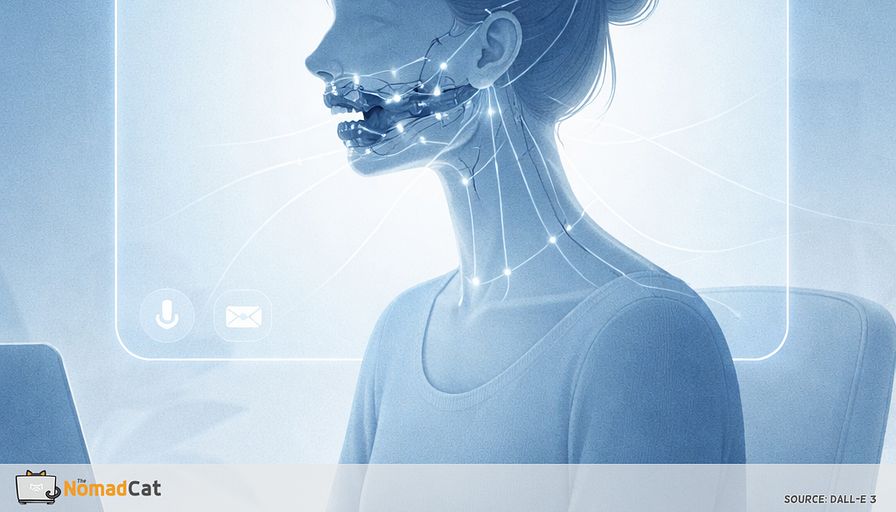
You can sit “correctly” for hours and still feel like your face is doing unpaid overtime.
I’m writing this from the usual remote setup: 2017–2023 in Berlin, mostly remote (including workations across Europe on bad chairs and worse desks), and now Lisbon, often past midnight. On those days, the jaw is weirdly the first place I notice the “professional stillness” landing.
Back is on the chair. Shoulders look normal on camera. And yet the jaw is set while you rewrite the same message for the 6th time. Lips press together during the awkward pause before you unmute. Tongue braces when you nudge pixels 1 by 1, trying to look calm, competent, neutral. The posture looks fine. The tension just moved somewhere more discreet.
This article names that pattern and treats it like what it often is: not a personality flaw, not a dramatic injury, more a high-frequency micro-hold that sneaks in under “professional stillness.” When movement feels visible (and therefore risky), the body picks smaller stabilizers that don’t show up in a Zoom rectangle.
Here’s what you’ll get, without turning your workday into another project:
- why jaw, tongue, and throat tension often tracks evaluation and camera-on moments more than “bad posture”
- how jaw and neck tend to travel together (so the jaw thing can become a neck/headache thing, quietly)
- the vague desk symptom set that makes no sense until you see the feedback loop (temples, trap heaviness, end-of-day stiffness)
- quick “2-second log files” to spot clenching without posture policing
- a small, meeting-safe patch (10–15 seconds) plus event-based cues that survive busy days
- simple guardrails for when it stops being an experiment and becomes a “get checked” situation
The goal isn’t perfect relaxation. It’s more options. Less time stuck in 1 mode. A bit more breathing room in the system, while the calendar stays rude and the next call starts in 2 minutes.
The desk jaw pattern
When your posture looks fine but your face is doing overtime
You’re sitting “correctly.” Back on the chair, shoulders not too high. And yet your jaw is doing that thing—especially in the moments where you have to look attentive while doing nothing: listening while someone screenshares, waiting out an awkward pause, holding a neutral expression while your brain is loud.
On a desk day, the face is the part that stays “on.” Even when the rest of you is trying to stay invisible.
Professional stillness pushes tension into hidden places
Once you notice it, it looks less like a personal flaw and more like a rule-set.
In a lot of work settings, moving looks distracted and not moving looks attentive. Add video calls and you get less mobility plus more self-monitoring (Bailenson, 2021). So the “allowed” movement migrates into small, socially invisible stabilizers:
- jaw set
- lips pressed
- tongue braced
- throat held a bit tight
It’s pressure showing up where it won’t be noticed on camera or across a meeting table.
Clenching is often a performance response
This brace tends to track evaluation more than temperament.
For many people, being watched, time pressure, and strict turn-taking reliably raise arousal. Camera-on meetings tend to dial that up compared to camera-off (Fauville et al., 2021/2022). In plain terms: your body treats “being watched” like a tiny exam, even if your mind is saying, “it’s just a status update.”
Workplace version: precision + observation + “don’t make it weird” can recruit the jaw as a quiet readiness response.
Not a diagnosis, more a high-frequency micro-hold
This is not “you have TMJ.” It’s often better framed as a low-grade, high-frequency behavior.
Bruxism research avoids moral labels and treats it as a behavior with levels of certainty (possible, probable, definite), because self-signs are not the same as diagnosis (Lobbezoo et al., 2013; updates 2018+). The jaw is small but always on call.
The issue is rarely 1 heroic clench. It’s thousands of tiny holds across a workweek.
The jaw and throat control panel
The jaw and neck share a bus
For desk work, jaw tension rarely stays local. Jaw and upper neck share wiring and reflex pathways, so when the jaw is “on,” the neck often comes online as quiet background stabilization (Sessle, 1987).
Headache physiology also describes a shared relay between face and upper-neck signals (sometimes called the trigeminocervical complex), which helps explain why face and upper-neck sensations can blur. Desk-life takeaway: this is why a “jaw day” can quietly become a “temples by 17:00” day, or a neck day, without a single dramatic moment. Reviews also show TMD and neck pain often co-occur (Armijo-Olivo et al., 2011).
That’s association, not proof of who started it.
Tongue bracing can shrink breathing
A tongue pressed to the palate, lips tight, throat held, jaw slightly set. It’s a clean way to reduce movement while looking calm on camera.
The immediate sign is simple: you notice the first real sigh only after a long focus block, like the system finally got permission to vent. When the mouth and throat “freeze,” breathing often gets smaller and higher, and the neck and shoulders may creep in as helpers. Some research in neck-pain groups finds breathing patterns can differ from controls (O’Leary et al., 2008), but you don’t need the paper to notice the cue.
The desk symptom set that feels vague until named
Sustained low-level activation, with too few true rest gaps, is a common exposure pattern in computer work (Visser et al., 2004). It often translates into:
- temple or behind-the-eye pressure
- “coat-hanger” traps that feel loaded all day
- end-of-day headache-y stiffness without a dramatic trigger
- neck compression after 60–90 minutes of focus
- upper back feeling a bit cardboard
Common pattern, not diagnostic. But it’s not random either.
Why the stiffness feels random
Delayed feedback hides the cause
Low-grade tension is cheap in the moment, expensive in aggregate.
The warning signals often show up only when attention drops. Like log messages that arrive late, you don’t connect them to what triggered them. Reduced variability can be protective short-term, but costly when it becomes the default (Hodges & Smeets, 2015).
The target is options, not perfect posture
Posture policing is about holding 1 “right” shape. Option-restoring is about having 6–10 workable shapes so the jaw brace doesn’t monopolize the whole day.
Not never slouch, but change positions more often.
This fits what many back-pain guidelines emphasize: activity and self-management over posture correction as the main lever (NICE NG59).
Treat it like a background process
To make this practical, treat tension like a background process stealing resources. The fix is not to find the emotional root cause in the middle of a sprint review. It’s to run tiny interrupts often enough that the system doesn’t get stuck in 1 mode.
Event-based cues help because they reduce the need for constant self-monitoring, and simple if-then plans tend to stick better than vague intentions. Or, said in my slightly backward syntax: you don’t need to remember all day—only at the moments that already happen.
Spot it without posture obsession
The 2-second log files
Rest position is a range, not a single correct shape. So the check is not “fix yourself,” it’s quick telemetry.
In the middle of real work, 2 seconds is about what you get. Try these 3 neutral checks:
1) Teeth: touching, or slightly apart? (Common conservative cue is lips together, teeth apart.)
2) Tongue: pressed hard up/back, or wide and soft?
3) Lips: tight and mouth “small,” or easy?
Just noticing is already half the intervention (NIDCR guidance). “Relax your jaw” can become another perfection project, fast.
A better target is often teeth not touching most of the time, not perfect jaw posture all day.
Good moments are the boring micro-pauses: waiting to unmute, hovering over Send, listening while someone screenshares. Video calls reduce mobility and increase self-monitoring, so discreet checks survive where big posture changes don’t (Bailenson, 2021).
Common tells and what they do and do not mean
People mention things like scalloped tongue edges, jaw fatigue when chewing dinner, morning tightness, throat clearing, clicking or popping.
These can be clues to get curious. They are not proof of bruxism or TMD on their own, and clicking especially is common even without pain.
A safer goal is frequency awareness, closer to tools like the Oral Behaviors Checklist that focus on “how often,” not “what does it mean.” Momentary sampling tends to catch more awake bruxism than recall, which tells you how sneaky this can be (Kraal et al., 2019).
A low-friction tracking option is 3 check-ins per day, anchored to events you already have, not timers. For example: after the 1st call, when lunch ends, and when the laptop closes. At each anchor, do the same 3 checks and note “yes/no” mentally.
Triggers that make it uncomfortably familiar
Waiting to speak on camera is a special kind of stillness. Eyes fixed. Neutral smile. Lips a bit tight. Tongue parked “just in case.”
With camera-on, arousal tends to run higher than camera-off (Fauville et al., 2021/2022), and Bailenson’s model helps explain why the face becomes the safe place to hold.
Precision tasks can do the same thing. Visual demand and don’t-mess-it-up attention can raise neck and trapezius activation even when you feel calm, and jaw bracing can join the stabilizer strategy.
Conflict avoidance uses similar mechanics. Polite disagreement often comes with held expression, lips pressed, tongue pulled back, breathing smaller. The body treats an awkward conversation like a performance test.
Then the contained day shows up later, when attention drops. A familiar cluster is traps loaded, temples busy, neck stiff, sometimes with the jaw mixed in.
The meeting-safe jaw patch
The 10 to 15 second patch
The smallest version starts with tooth-space. Keep the lips together, but let the teeth not touch and think “jaw a bit heavy,” not “relax completely.” Conservative self-management guidance often uses this baseline cue (NIDCR; de Leeuw & Klasser, 2018).
Once the teeth separate, the next common brace is the tongue.
Then soften the tongue. Not a perfect posture thing, just less bracing up and back. A useful sensory target is a tongue that feels wide and resting.
Add 1 slow closed-lip exhale, longer than the inhale. The point is modest: a quiet downshift you can do on a call without performing a breathing exercise. If it helps, think “make the exhale slightly longer,” nothing more.
Success looks boring. Not instant calm. Just less time spent in the default clamp and a bit more variability across the hour.
Think: clearing a tiny cache so it doesn’t eat the whole machine later. Microbreak research suggests even short, frequent pauses can reduce discomfort over time (McLean et al., 2001).
Event cues
Time-based reminders are cute on day 1 and dead by day 3. Event-based cueing is simpler. If X happens, then patch.
Pick 1 or 2 triggers you hit constantly:
- right before Send or right after
- mute or unmute
- stop screen sharing
- when a build/export finishes
- when a tab closes
If someone calls your name mid-exhale, you just stop. That’s not failure, that’s the feature.
Signals and stop rules
Boring signs it is working
Improvement usually shows up as trends, not fireworks.
Over 1–2 weeks, some boring signals that may appear are:
- neck feels “rebooted” faster after back-to-back calls
- less end-of-day trap heaviness
- fewer temple-pressure, behind-the-eye headaches
- deep breaths come easier after a focus block
- less throat clearing or tight-swallow feeling
If you want a minimalist log, 1 daily data point is enough: at 18:00, rate neck or trap heaviness 0–10. I like 1 number because it keeps me honest and doesn’t turn into another spreadsheet.
If logging becomes another task, drop it. Keep only the transition cues (mute/unmute, Send, screen-share) and let that be enough.
Guardrails and referral rules
This is not a TMJ diagnosis tool, and it is not a substitute for clinical evaluation. Bruxism and TMD assessment has levels of certainty for a reason (DC/TMD Schiffman et al., 2014; Lobbezoo et al., 2013; 2018+).
Treat this as a reversible experiment in reducing baseline bracing.
If any of the following show up, stop experimenting and get checked:
- sharp or worsening jaw pain, or pain that feels “electrical”
- jaw locking or you cannot open or close normally
- significant tooth pain, broken tooth, or strong sensitivity
- a noticeable bite change that persists
- new severe headache, or headache with red-flag features
- facial numbness, weakness, tingling, or speech trouble
- swelling, fever, or feeling unwell
- difficulty swallowing or breathing
If symptoms persist, escalate, or start changing function, it becomes a medical question and deserves a proper assessment.
If your days are 10 hours of desk time, camera-on meetings, and lunch that somehow happens while typing, it makes sense that tension ends up in the smallest “allowed” places.
The key idea is simple: jaw, tongue, and throat bracing is often a quiet performance response, not a character flaw and not automatically a diagnosis.
Because jaw and neck tend to travel together, those tiny micro-holds can turn into temple pressure, trap heaviness, and end-of-day stiffness.
The fix is not perfect posture or constant self-policing. It’s more variability—small interrupts at transitions, repeated often enough, are usually enough to change the week.


