 Gilles Crofils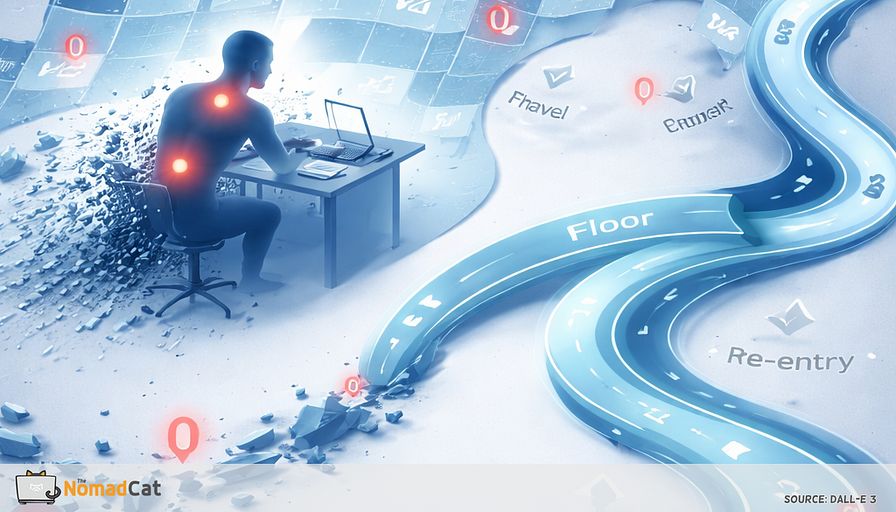
If your workdays were a clean timeline, most health plans would work. But your week is lumpy. You can stack 10 chair-hours that look “fine” on a calendar, eat at your desk, let meetings eat the gaps, and only notice the damage when things finally go quiet at 20:00. Tight shoulders. Stiff neck. Dry eyes. A low back with opinions. The 15:00 dip. Sleep that turns weird for no reason.
That delay is the trap. Your body is throwing warnings like system alerts, just late. And most plans score you like life is stable and predictable. Daily streaks. Fixed schedules. “It only counts if it’s 45 minutes and sweaty.” So when a travel day, a deadline sprint, or a dinner that runs long hits, the system does what brittle systems do. It turns partial credit into zero. Then comes the failure cascade. Miss, guilt, avoidance, restart on Monday.
This article is about changing the scoreboard, not your personality. You’ll see why pass fail scoring makes normal disruption feel like personal failure, and which 3 success definitions break first for desk-work reality.
Then we’ll get practical with a setup that survives ugly weeks
- minimum viable consistency that still counts on bad days
- 2 modes that fit inside a demanding schedule, normal-mode and chaos-mode
- re-entry rules that make misses cheap so you don’t wait for the next “fresh start”
No polished optimism. No magic morning routine. Just a more durable definition of “done” so your effort can compound, even when your calendar is on fire.
The success definition trap
Your week is lumpy not linear
You can have 10 chair-hours that look fine on paper. Desk lunch. Meetings that eat the gaps. Then when you finally stop at 20:00, the signals show up late, like delayed warnings.
Tight shoulders. Stiff neck. Dry eyes. A low back that starts grumbling. The 15:00 dip. Sleep that suddenly gets weird.
That delay matters because most health plans assume your days behave like a smooth timeline.
Side note from my own desk life across Beijing and Berlin, and now Lisbon, often past midnight: my early signal is upper-back tightness, and yes, ok, working all day without eating, drinking, or moving is not a superpower.
Knowledge work is not metronome life. It is fragmented inputs and noisy outputs.
- Context switching
- Meetings that expand
- Travel days
- “Just 2 emails” after dinner that becomes 45 minutes
Add after-hours pressure, and recovery gets squeezed, not scheduled. When your inputs are high-variance, any rigid definition of success expecting low variance will treat normal adaptation as failure.
That is the real failure mode behind repeated attempts. The scoreboard is incompatible with volatility, so you fail before behavior even has a chance to compound.
The fix is not more willpower. It is redesigning the definition of done so it still works during travel, sprint weeks, and late meetings.
When pass fail scoring creates a failure cascade
The loop is designed not random
The key bug is simple. The system converts partial credit into zero.
One late meeting, one travel day, one dinner that runs long, and suddenly you are off plan. Then comes the clean fantasy of a fresh restart.
Monday. The 1st. Next month.
You know the script.
Binary rules take a normal miss and turn it into a verdict. Mechanism-wise it often goes like this.
- Miss
- Label it as failure
- Guilt or shame
- Avoidance, like skipping the next session or stopping tracking
The disruption was ordinary. The scoring made it personal.
Put that on top of desk-work volatility and you get repeated restarts even when you care. And you start getting labeled inconsistent when you are just operating inside a messy system.
It’s like treating “I did 10 minutes” as the same as “I did nothing.”
The 3 success scores that break first
Streaks are consistency cosplay
Streak success means daily completion becomes the unit of worth. Travel days, late nights, illness, deadline sprints, and suddenly the app says 0.
Then people do tiny nonsense to protect the number. Logging something while changing planes. Doing 3 minutes of half-pushups at midnight so the calendar stays green.
Gamification can help. But the metric quietly becomes the goal.
The worst part is when the streak breaks and it feels like progress was deleted. Now you are waiting for Monday again.
Fixed schedules assume you own your calendar
Schedule success is when it only counts if it happens at 06:00. Or only if Sunday meal prep happens. Or only if evenings stay calm.
That plan assumes your calendar belongs to you. For many desk jobs, it does not.
One real-world proxy is sleep timing variability. If bedtime and wake time drift a lot, it is a sign your time cues are unstable. And once the schedule is unstable, meals and movement get unstable too.
When cues keep moving, habits do not stick because the environment is not stable enough to hold them. It is not a character flaw.
Intensity only makes hard weeks count as zero
Intensity success is when a workout only counts if it is 45 to 60 minutes, sweaty, heavy, the full ideal version.
During a hard week, cognitive load is high and the full version becomes rare. So the scoreboard fills with zeros.
The boring but freeing counterpoint is this.
- Some activity is better than none
- Maintenance often needs less than building
- Short bouts can still matter, especially when they add up
If your plan only recognizes the ideal version, it will fail exactly when you need it most.
Minimum viable consistency beats perfect weeks
The floor that still counts
Floors work because they change how feedback behaves on bad days.
Minimum viable consistency is a definition of done for ugly weeks.
Not a new routine. Not habit stacking. Not lowering standards forever. Just a small floor that keeps the thread alive.
And yes, I’m the guy who can work a full day without eating or drinking. It doesn’t feel dramatic in the moment. It just makes the next 2 days worse.
Floors work like good engineering because they prevent binary collapse. Instead of hit the ideal or get a zero, you get partial credit you can bank.
MVC is easier when it is pre-decided and tiny. Examples only.
- Movement 5 to 12 minutes of anything, or 1 hard set, or a short walk
- Micro-bouts 2 short sessions split across the day when time is chopped up
- Food anchor a default meal that is protein plus fiber when everything is chaos
The goal is not to win the week. The goal is to keep the system running.
Two modes without the identity drama
This works partly because it protects the story you tell about who you are.
Normal-mode can be ambitious.
Chaos-mode must be frictionless and smaller, but still a win.
Lapses are normal events, not proof that the whole system is broken. Think less drama, more continuity.
Chaos-mode gets reliable when you pre-decide it with if-then rules, like writing fallback paths before a real work fire drill.
Example.
- If meetings eat the evening, then do 8 minutes and 1 set, and stop
It reduces decision load. It also avoids the classic trap where you negotiate with yourself at 22:30 and somehow lose.
Re-entry rules make misses cheap
A re-entry rule is the smallest next action after a miss, decided in advance, so you do not wait for Monday.
It breaks the shame loop. Missed once stops meaning lost control. It becomes a normal event with a normal response.
Example: you miss Thursday because the client call eats the evening. Friday is not “make up day.” Friday is the easy version, 8 minutes, done. The streak story never gets a chance to start.
Examples, not commandments.
- Next workout is always the easy version, even if you should do more
- Next meal is protein plus plants, no compensating theatrics
- Next day includes 10 minutes outside
Before any plan looks impressive on paper, it helps to check 3 things quietly.
- Does it have a floor
- Does it have a chaos-mode
- Does it have a re-entry rule
Without those, it is basically a streak in disguise.
A forensic checklist before you restart
The brittle plan detector
Tools and apps can look premium and still fail the one test that matters under deadlines and travel.
Before the next attempt, run a check on the scoring system, not on your motivation.
- What counts as success on a bad day, not a good one
- When you miss, do you get guidance or a big red zero
- Does it assume fixed mornings or calm Sundays
- Is there a chaos-mode version that still feels like a real win
- Is there a re-entry rule for the next action after a lapse
- Can you still pass if the next 2 weeks are ugly
If the last answer is no, the plan is not designed for your life. It is designed for a calmer one.
When accountability sounds like a verdict
That mismatch moment is predictable. You adapt rationally to a deadline, and the tool reports failure anyway. You miss 1 session because a 17:30 meeting slides to 20:10, and the app turns the whole week red.
Feedback that feels like a personal verdict tends to reduce performance. Feedback focused on the task and the process tends to help.
So if your system keeps handing you verdicts, you will start avoiding the system. Not because you are fragile. Because it is unpleasant and, honestly, kind of dumb.
Durability is the actual standard
You were scored by rules built for stable conditions, then blamed for living in unstable ones.
The fix is configuration.
Floors, chaos-mode, and re-entry rules make misses cheap. That gives effort time to compound.
Sleep can still be the unsolved variable on many desks, mine included. So durability beats perfect plans.
Tomorrow will still be messy. That is fine.
The real problem is not motivation. It is scoring. Most weeks don’t need a new plan. They need a definition of “done” that doesn’t turn Tuesday into a verdict.


