 Gilles Crofils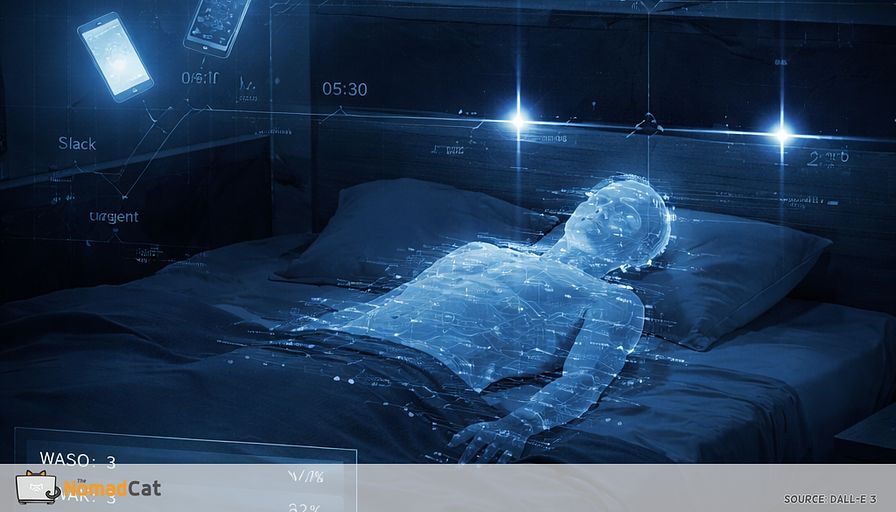
Laptop finally closed at 00:30. You fall asleep fast. The tracker (or the clock math) says 7–8 hours. And still, morning shows up with that thin, foggy feeling, like your sleep got watered down.
When that happens, the problem is often not how long you slept. It is how broken up the night was.
This article is for the version of you who can’t relate to most sleep advice because you are not lying awake for 2 hours. You are out quickly. You just keep getting pulled back toward the surface at 02:40, 04:10, 05:30. Sometimes you remember it, sometimes you don’t. Either way, the next day feels like you are running on low battery saver mode.
We are going to treat this less like a morality play and more like debugging.
Here is what you will get, in plain terms:
- A clear model of sleep fragmentation and why it can feel like burnout even when “hours in bed” looks fine
- The few measurements that actually matter here: WASO, awakenings, sleep efficiency. And why they are context, not a diagnosis
- Why desk work and after-hours reachability trains the brain to sleep on standby, even with notifications off
- A tiny 3-morning continuity check that gives signal without turning your life into a tracking project
- Low-friction changes that reduce the wake-and-reentry loop. Things like making reachability explicit, moving the “portal” out of arm’s reach, and containing open loops without a big bedtime production
No perfect bedtime aesthetic. No branded coaching vibe. Just a practical way to get your nights back into fewer, longer blocks so the next day feels less like pushing a heavy browser tab uphill.
When 8 hours in bed still feels like 4
Fragmentation is not insomnia with better marketing
Often the issue is not duration. It is continuity.
“Chopped up” sleep can happen even if you don’t remember being awake. Brief awakenings and arousals are real events in sleep scoring, and they add up as wake time after sleep onset.
A simple way to think about it: sleep gets interrupted, then you spend time trying to drop back in.
- WASO: how many total minutes you were “up” after you were already asleep
- Number of awakenings or arousals: how many times you got bumped toward the surface (even if you don’t fully wake)
- Sleep efficiency: how much of your time in bed was actually sleep (not tossing)
You will see cutpoints like sleep efficiency <85% and WASO >30 minutes used in research. Helpful for context, not a diagnosis—and for desk workers it mostly tells you whether the night was one solid block or a bunch of small reboots.
Here’s the basic mechanics model:
Light-sleep window → cue (clock/phone/thought) → arousal → re-entry time.
Fragmentation is mostly the re-entry time adding up.
Memory of the night is low-resolution. You might surface, check the time, and not fully register it. Or you wake just enough to scan tomorrow’s tasks. Or you wake up 10 minutes before standup time even on Saturday.
So the main question is less “how do i fall asleep faster?” and more “what happens at 02:40?” Even if you can’t recall every micro-awakening, the next-day signal (“i slept, but i did not recover”) still counts.
Sleep maintenance is the quiet culprit
Most sleep advice targets the wrong bug
This is why fragmented sleep can look like burnout even when your hours did not change. Most popular advice targets sleep onset: screens, routines, perfect darkness. Useful, sure. But if you fall asleep fast, the real leak is often the wake and re-entry loop.
Continuity failures feel like tiny stress spikes
Before changing anything, it helps to name what’s happening: the night is not “bad,” it is interrupted. Each small wake-up often feels like a mini stress spike. Your brain does a quick “status check”—time, tasks, threat—and that alone can make re-entry slower.
Work stress matters here. If you live at a desk and often past midnight, that “ready mode” can become the default.
A 3-morning no-gadget continuity check
For 3 mornings, capture a tiny log. Debugging, not “tracking sleep.”
- NWAK: how many awakenings you remember (even if brief)
- WASO estimate: rough total minutes awake after first sleep
- Time-checking: did you look at the clock or phone, yes/no
- Continuity felt: 0–10 for “did this feel like 1 block or 12 fragments”
If all you have is a simple “did i wake up in the middle of the night or early morning?” that still counts as signal.
Why desk work trains you to sleep like you are on standby
Reachability makes every night a maybe
This gets worse when the pressure is not the message itself, but the expected response time. If late pings happen sometimes, your brain learns that any night can be the exception. Conditioning, not a personal flaw.
If a mental model helps: background processes, not willpower.
Telepressure (the feeling you must respond quickly) is linked with poorer sleep quality, largely because it makes it harder to switch off mentally after work.
So the brain runs an alert-listener in the background. Even with notifications off, it doesn’t fully idle, and lighter sleep becomes easier to interrupt.
Unfinished work resurfaces at the weak points of the night
Unfinished tasks stay mentally “open.” So when sleep gets lighter between cycles, a thread with a client, a budget decision, or a half-written doc can pop up.
This is normal cognition doing what it was built to do. Not fun, but not mysterious.
Silent cues keep the brain in check mode
The bedroom itself can become an “on duty” context. A phone on the nightstand can be enough. Your brain expects the possibility of a vibration.
Time-checking is the classic sleep-maintenance amplifier. A small wake-up becomes forecasting, then planning, then mild panic. And now you’re doing sprint planning at 04:10.
What fragmented sleep steals from a desk day
Vigilance wobbles first and everything gets sticky
When sleep is chopped, the first thing that tends to degrade is vigilance, not “intelligence.” The desk version is boring:
- slower reading
- more re-reads
- staring at a ticket without starting
- tiny typos
- missing 1 line in an email thread
- losing the plot in a meeting and coming back 30 seconds later
If those show up, compare them to your NWAK/WASO notes—sticky days often match the most chopped nights.
Then attention instability leaks into behaviors. More double-checking, more tabs “just to be safe,” more Slack re-open loops, more “did i send that” scanning. This does not mean anything clinical. It is just what happens when your attention flickers and you try to compensate.
Emotion regulation shrinks and it looks like burnout
Over time, a fragmented baseline can hit mood regulation. Small blockers feel bigger. Feedback stings more than it should. Patience gets short in places where you are normally fine.
So the goal is not a perfect bedtime aesthetic. It is reducing on-call cognition with small defaults. The loop nobody asked for is:
after-hours expectations → telepressure and rumination → more fragmented sleep → less frustration tolerance → more controlling and checking behaviors
Low friction changes to reduce on-call sleep
Make reachability explicit with 1 sentence
Ambiguity is expensive. If “urgent” is undefined, the brain keeps simulating edge cases at 04:10.
Scripts that sound like a colleague, not an HR poster:
- “Offline after 20:30. If urgent, call me.”
- “Checking once at 22:00. Anything else goes in the channel for tomorrow.”
- “If it blocks a release, text. Otherwise i reply in the morning.”
Move the portal out of arm’s reach
You don’t need perfection, just fewer automatic checks. The idea is simple: reduce cues that train the bed to mean “monitoring.”
A compact setup that reduces dashboard mode:
- charge the phone outside the bedroom if possible
- if not, place it across the room, screen-down
- remove the laptop from the bedroom
- turn the clock away (or remove it)
- disable raise-to-wake and lock screen previews
The evidence on the mere presence of a phone or workstation is not perfect, but the logic is pretty straightforward. Fewer cues, fewer checks.
Contain open loops without making bedtime a ceremony
A low-drama option is a 2-minute triage. If checking messages is truly necessary, do it once, then write 1 line on paper: “tomorrow first move.”
I studied fundamental physics in Paris, and I still end up at my desk past midnight more often than I want. So I keep the log tiny, not heroic.
If you still wake up, the rule is: log it, do not fix it. Write 1 keyword (not a plan) and go back to bed. It reduces the monitoring spiral that makes awakenings longer.
Define success in human terms, not sleep-score terms. Track fewer alert moments, faster return to sleep, and less morning dread using the simple continuity notes (NWAK, rough WASO, 0–10 continuity felt). Hours matter, but continuity pays the rent.
If you fall asleep fast but keep popping awake at 02:40, the issue is rarely discipline or bedtime aesthetics. It is continuity. I’m 52 and if I don’t police this, I can work through the night—then pay for it the next day.
The useful lens here is debugging: look at WASO, awakenings, and sleep efficiency as context, then look for the triggers that keep pulling you back online. Reachability, time-checking, and open loops are common ones.
The good news is you do not need a perfect routine. Small defaults work: make after-hours expectations explicit, move the phone or clock out of grab range, and do a 3-morning continuity check so you change the right thing, not everything.


