 Gilles Crofils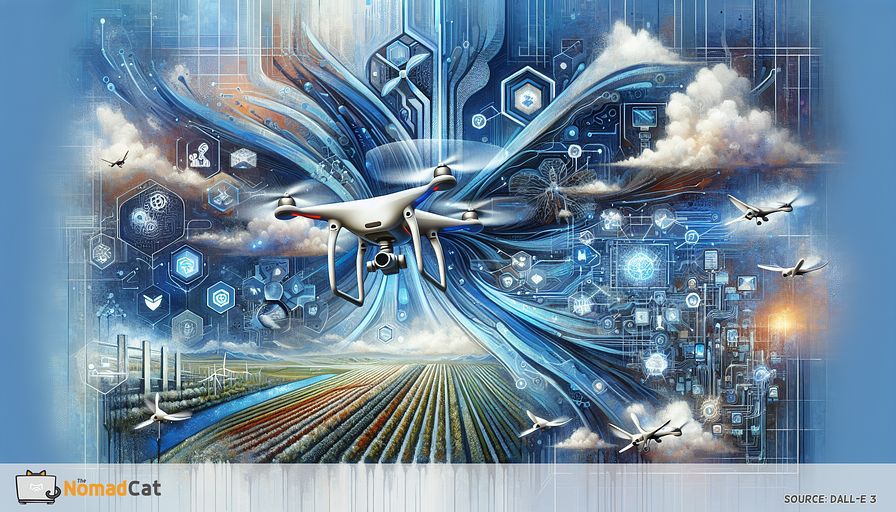
Advanced drone technology: a new frontier
From flying toys to powerful tools, drones have come a long way in a short period. Once largely confined to the realms of surveillance and aerial photography, they have now carved out a significant role in the fields of robotics and automation. What stands behind this transformation is the integration of advanced technologies like AI and machine learning.
In recent years, the synergy of AI and drones has unlocked a universe of new possibilities. Machine learning algorithms enable drones to interpret vast amounts of data, allowing them to adapt to changing environments and make real-time decisions. This pivotal enhancement has transformed drones into versatile machines capable of executing complex tasks with precision and efficiency.
The impact of these technological advancements is far-reaching, touching various sectors from agriculture to logistics and beyond. Drones have become indispensable in modern industrial applications, revolutionizing how businesses operate. In the world of agriculture, for example, drones are used for crop monitoring, pesticide spraying, and even planting seeds. Simultaneously, in logistics, they're cutting delivery times and reaching places that were once deemed inaccessible.
As we delve deeper into their diverse applications, it's clear that drones are not just a fleeting trend but a cornerstone of future innovation. With AI and machine learning continuing to evolve, the capabilities of drones are only set to expand, creating new opportunities and reshaping the landscape of numerous industries. Let's explore how drones are being utilized today and what lies ahead for this fascinating technology.
Industrial applications of drones
In my experience as a Chief Technology Officer, I've seen firsthand how drone technology is revolutionizing various industries. The adoption of drones in agriculture, disaster management, infrastructure inspection, and public safety is creating new benchmarks for operational efficiency and innovation. Let me walk you through some of the exceptional ways drones are creating real-world impact.
Agriculture: precision and efficiency
In agriculture, drones have redefined precision farming. Equipped with sensors and cameras, drones can gather vital data on crop health, soil conditions, and plant growth. This data allows farmers to make informed decisions, whether it's optimizing irrigation or applying fertilizers where needed.
Examples of drone use in agriculture:
- Monitoring crop health through multispectral and thermal sensors, identifying stressed plants and disease outbreaks early on.
- Optimizing pesticide application by targeting specific areas, reducing chemical use, and increasing yield.
- Planting seeds and managing fields more efficiently using automated systems.
These capabilities help farmers allocate resources more effectively, ultimately saving time and reducing costs.
Disaster management: rapid assessment and coordinated response
In times of disaster, drones have become invaluable tools. They can quickly survey affected areas, providing real-time data that is pivotal for coordinating relief efforts. This swift action is crucial for saving lives and mitigating property damage.
Notable applications in disaster management:
- Assessing flood damage and mapping out affected regions to expedite rescue operations.
- Delivering medical supplies to areas cut off from traditional transportation routes.
- Using thermal imaging to locate survivors under rubble in earthquake-hit zones.
The ability of drones to access dangerous or hard-to-reach areas ensures that first responders can prioritize their efforts effectively, making disaster management operations more efficient and life-saving.
Infrastructure inspection: enhancing safety and accuracy
Another significant application of drones is in infrastructure inspection. Traditional methods of inspecting bridges, power lines, and pipelines often involve risks to human safety. Drones mitigate these risks by providing a safer, more efficient alternative.
Key use-cases in infrastructure inspection:
- Inspecting bridges for structural weaknesses without the need for scaffolding or cranes.
- Monitoring power lines and identifying faults or vegetation encroachments that could cause outages.
- Inspecting pipelines to detect leaks or corrosion, ensuring the integrity of vital energy infrastructure.
The precision and detail offered by drone inspections not only improve safety but also enhance the accuracy and frequency of assessments.
Public safety: proactive measures and surveillance
Public safety agencies are increasingly leveraging drones to enhance their capabilities. From crowd monitoring to search and rescue missions, drones are proving to be indispensable tools.
Examples in public safety:
- Monitoring large public events to maintain security and quickly respond to potential threats.
- Using aerial views to coordinate search and rescue missions in remote or hazardous areas.
- Assisting in traffic management and accident assessment to improve road safety.
By providing real-time situational awareness and reducing response times, drones are helping public safety agencies protect and serve communities more effectively.
As we harness the power of these advanced technologies, it’s clear that drones are not just transforming industries—they are redefining the way we approach complex problems and drive innovation. As I continue to see these technologies evolve, I am confident that the future holds even more extraordinary applications for drones.
Future prospects of drone technology
Looking ahead, I see an exciting horizon for drone technology. The integration of advanced sensors has significantly broadened the potential applications for drones, expanding their capabilities and making their use more widespread across various sectors. As sensors become more sophisticated, drones are now equipped to handle increasingly complex tasks which were once thought impossible.
Environmental monitoring
One promising application is environmental monitoring. Drones equipped with specialized sensors can monitor air quality, track wildlife, and assess ecological changes over time. This capability is pivotal for organizations dedicated to preserving our environment. By providing accurate, real-time data, drones help us make informed decisions about conservation efforts and climate change mitigation.
Specific uses in environmental monitoring include:
- Tracking deforestation and illegal logging to protect forested regions.
- Monitoring water bodies for pollutants and harmful algal blooms.
- Surveying wildlife populations to better understand and preserve ecosystems.
Smart infrastructure inspection
Drones are also revolutionizing how we inspect and maintain infrastructure. With advancements in sensor technology, drones can now detect minute structural weaknesses in buildings, bridges, and other critical infrastructure. This early detection capability can prevent catastrophic failures and ensure public safety.
Innovations in infrastructure inspection include:
- Using drones with lidar sensors to create detailed 3D models of infrastructure for analysis.
- Employing thermal sensors to identify areas of heat loss in buildings, promoting energy efficiency.
- Deploying drones to inspect hard-to-reach areas such as the underside of bridges or high-rise buildings.
Revolutionizing delivery and logistics
Another futuristic scenario I envision is the use of drones for delivering medical supplies to remote or underserved locations. This can be transformative for healthcare in rural areas, where timely delivery of medicines and medical devices can save lives. Drones can overcome geographical barriers that traditional transportation methods cannot.
Potential applications in delivery and logistics:
- Transporting blood and organs for transplants between hospitals more efficiently.
- Delivering vaccines and medications to remote clinics, ensuring timely access to healthcare.
- Providing supplies to disaster-stricken areas where infrastructure has been compromised.
The future of automation and robotics
As we continue to push the boundaries of what drones can achieve, automation and robotics will play a crucial role in our daily lives. The synergy between drone technology and AI-driven automation is set to create a new paradigm in various industries, enhancing productivity, efficiency, and accuracy.
Automation powered by drones can:
- Optimize warehouse management through automated inventory tracking.
- Improve agricultural outputs by automating labor-intensive tasks such as seeding and crop monitoring.
- Streamline urban planning by providing precise and detailed geographical data.
In my role, I have seen how these advancements are not just theoretical but are beginning to reshape how businesses operate and how societies function. The continuous evolution of drone technology, driven by advancements in sensors, AI, and machine learning, promises a future where the capabilities of drones are limitless. This innovation will continue to revolutionize sectors, ensuring that industries become more efficient, safer, and smarter.
It's an exciting time, and I am eager to witness and contribute to the breakthroughs that lie ahead. The potential of drones is vast, and as technology evolves, so too will the possibilities, driving us toward a future where drones are integral to our daily lives and global operations.


