 Gilles Crofils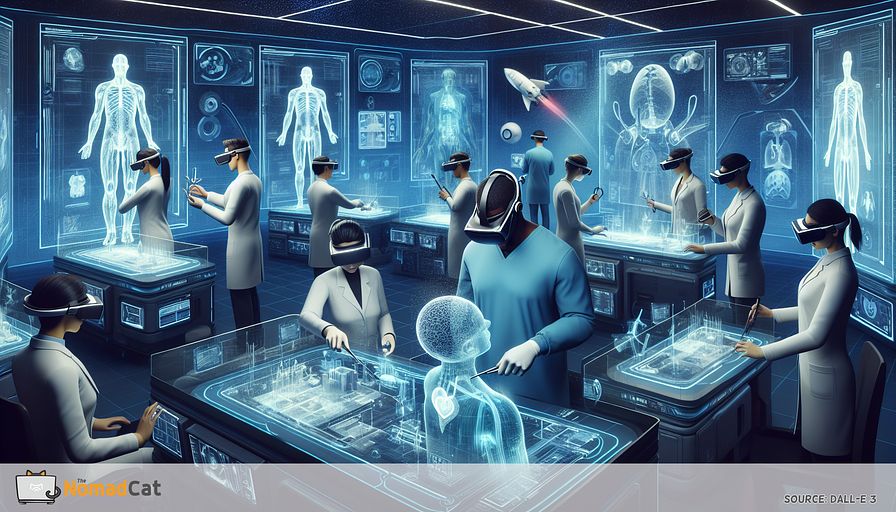
Anecdotes from the Frontlines of Training: A VR Revolution
Picture this: a room full of professionals, diligently taking notes as a projector hums in the background, displaying slides that have seen better days. This scene, once the epitome of corporate and technical training, is now being charmingly disrupted by an innovative force: Virtual Reality (VR). I must confess, as a Chief Technology Officer, the shift from traditional, somewhat yawn-inducing, training methods to immersive VR experiences feels like swapping out a bicycle for a sports car in the professional development race.
VR isn’t just changing the game; it's creating a whole new playing field. Across sectors, from healthcare to aerospace, VR allows professionals to not only see but also interact with their learning materials, stepping into a 360-degree world where lessons come to life. This transformation is marked by a noticeable leap in efficiency and engagement in training processes.
The promise of VR technology in enhancing the depth and retention of learning is not just exciting—it's revolutionary. The hands-on experience without the traditional risks associated with practical training? It’s akin to having your cake and eating it too, but with the added bonus of not having to clean up any mess afterwards. This shift is a vivid example of how technological advancement doesn't just change how we do things; it elevates our entire approach to professional development and skill acquisition.
As we delve further into the applications and benefits of VR across various sectors, it becomes clear just how profound an impact this technology is set to make on professional training. The immersive, interactive nature of VR offers a glimpse into a future where learning is not just about seeing and hearing but doing and experiencing—blurring the lines between theory and practice in the most exhilarating way possible.
Exploring the Versatile World of VR in Training: A Sector-Wide Impact
The beauty of Virtual Reality (VR) technology lies not just in its capacity to whisk us away to another world from the comfort of our office chair but in its profound potential to reshape professional training across a spectrum of industries. As we navigate through the various applications of VR, it's clear that sectors as varied as healthcare and aerospace are already on board this high-speed train towards futuristic learning and skill acquisition. Let's take a closer look at how these fields are leveraging VR to not only enhance training outcomes but also, quite literally, save lives and resources in the process.
Revolutionizing Healthcare Training with VR
In the realm of healthcare, the stakes couldn't be higher. Training to save lives is a monumental responsibility, and VR is stepping in as a game-changer. Imagine, if you will, the prospect of performing complex surgical procedures without the risk of a single incision on a real human being. This is the reality VR has facilitated for medical professionals.
- Simulated Surgical Training: Through VR, novice surgeons can practice intricate procedures, from heart surgeries to delicate neurosurgical operations, within a controlled, risk-free environment. These simulated experiences not only enhance the surgeon's skill set but significantly reduce the learning curve associated with mastering such complex tasks.
- Enhanced Diagnostic Skills: VR-based diagnostics training allows medical professionals to step into their patient's shoes, or more accurately, their bodies. Through immersive 3D simulations, they can explore the pathology of diseases with a level of detail and realism that textbooks simply cannot match.
- Improved Patient Care: By using VR in patient interaction simulations, healthcare providers can improve their bedside manners, communication skills, and overall patient care. This aspect of training is often overlooked in traditional methods but is crucial for holistic patient treatment.
A leading voice in medical education, Professor Aiden Walker, shares, "VR in healthcare training isn't just about improving technical skills; it's about instilling a deeper understanding and empathy towards patients, which ultimately leads to better healthcare outcomes." This sentiment is echoed across the board as VR paves the way for a new era of empathetic, skilled, and confident healthcare professionals.
Aerospace Training Takes Flight with VR
Meanwhile, up in the stratosphere of aerospace, VR is transforming how pilots and engineers prepare for the challenges of flight and space exploration. The margin for error in this sector is minuscule, and the cost of traditional training, astronomical. Enter VR, the solution that's both cost-effective and profoundly impactful.
- Flight Simulation Excellence: VR offers a remarkably realistic piloting experience, from the cockpit environment to weather conditions and emergency scenarios. This immersive training prepares pilots for real-world challenges they might face, all from the safety of a simulator.
- Space Exploration Preparedness: For astronauts, VR training is not just beneficial; it's indispensable. Simulating extraterrestrial landscapes and zero-gravity environments, VR helps astronauts adapt to the physical and psychological demands of space travel before they ever leave Earth.
- Engineering and Maintenance Training: Aerospace engineers also benefit from VR technology, using it to explore and interact with complex aircraft systems and components. This hands-on approach improves understanding and efficiency in maintenance and troubleshooting tasks.
A sentiment from the aerospace sector's thought leader, Dr. Emily Chen, puts it succinctly: "With VR, we're not just preparing our workforce for what's to come; we're equipping them with the skills to innovate for the future of flight and space exploration." This vision captures the essence of VR's role in aerospace: an instrument not only for training but for inspiring the next frontier of discovery and innovation.
Embarking on a High-Fidelity Future of Training
As we glimpse into the transformative influence of VR across healthcare and aerospace, it's evident that we're standing on the precipice of a new dawn in professional training. VR's ability to simulate complex scenarios with unparalleled realism offers a twofold benefit: enhancing skill sets while reducing risks and costs. The safety net it provides, allowing for errors and learning without real-world repercussions, is unparalleled.
In both sectors, VR not only addresses the immediate objectives of training — be it performing a life-saving surgery or piloting a commercial airliner — but also nurtures soft skills such as decision-making, problem-solving, and empathetic patient care. The potential for VR in professional development is as vast as the virtual worlds it can create, offering a sandbox for innovation, experimentation, and growth.
My journey as a Chief Technology Officer has shown me that embracing cutting-edge technologies like VR is not just about staying relevant; it's about pushing the boundaries of what's possible in training and education. As we continue to explore and expand the applications of VR, we're not just preparing professionals for the challenges of today; we're equipping them for the unknowns of tomorrow.
Conclusively, the sectors of healthcare and aerospace are just the beginning. VR's footprint in professional training is expanding, promising a future where learning is not only about absorbing information but experiencing and mastering it in a way that was once the stuff of science fiction. The journey of VR in training is an exhilarating ride into the future, and I, for one, am thrilled to be a part of it.
The Future of VR in Professional Training
Reflecting on the journey VR has taken us on so far, it's like leafing through a science fiction novel that’s leaping off the page and into reality. As a Chief Technology Officer deeply entrenched in the cutting-edge realms of technology, I've seen firsthand the metamorphosis of Virtual Reality from a niche entertainment gadget to a powerhouse tool in professional training. And yet, we stand merely at the brink of its potential.
Expanding Horizons: VR's Integration Into Training Methodologies
The promise of VR in professional development is not just a gleam in the eye of technologists and educators alike; it's becoming the backbone of future-proof learning strategies across sectors. The natural progression of VR's capabilities, thanks to relentless innovation and refinement, seems poised to embed itself further into our training methodologies. This expansion isn't just hopeful speculation; it's being sculpted by the tangible benefits we've observed in sectors like healthcare and aerospace, where VR's application has been nothing short of revolutionary.
The beauty of VR is its chameleon-like ability to adapt and suit the needs of virtually any sector that requires hands-on learning without real-world risks. Whether it's law enforcement navigating high-stress interaction scenarios, educators creating immersive histories of ancient civilisations for students, or even service industry professionals perfecting their craft in safe, simulated environments, the potential arenas for VR's influence are boundless. The evolving capabilities of VR ensure that its integration into professional training will be both seamless and synergistic, providing a fertile ground for innovation and excellence.
Preparing Tomorrow's Workforce With State-Of-The-Art Tools
The notion of preparing today's professionals for tomorrow's challenges may sound like a daunting task. However, with VR, it's not only achievable but exhilarating. The ability to simulate intricate, high-stakes tasks in a controlled environment means that we can arm our workforce with an experiential knowledge base unlike any other. This depth of preparation paves the way for a new era of proficiency, confidence, and innovation in professional spheres. It's about harnessing the magic of VR to not just inform but transform our approach to learning and skill development.
The pivotal role of VR in training sectors across the board signifies a paradigm shift in how we value and invest in professional development. The importance of adopting such cutting-edge tools cannot be overstated. It’s an immersive leap into not just elevating the skill sets of our professionals but enhancing their adaptability, critical thinking, and problem-solving capabilities. As we glance into the future, the widespread application of VR in training mechanisms seems not just advantageous but essential for cultivating a robust, forward-thinking workforce.
A Future Ripe with Possibilities
In wrapping up this exploration of VR’s revolutionary potential in professional training, it's hard not to feel a buzz of excitement for what lies ahead. The landscape of professional development is changing, morphed by the capabilities of VR into something richer, more engaging, and far-reaching. The sectors currently leading the charge in VR training only represent the first wave of adopters in what promises to be a sweeping change across industries worldwide.
As we stand on this threshold of innovation, the future of VR in professional training is not just promising; it's brimming with possibilities. The extent to which VR will redefine our learning and development methodologies is only limited by the scope of our imagination and our willingness to embrace change. For those of us steering the ship of technological advancement, it's a thrilling time to be alive.
Ultimately, the journey of VR in professional training is akin to stepping through a portal to a new dimension of learning—one where experience, interaction, and engagement are the keystones. The revolutionary potential of VR in professional development is not just a distant dream; it’s unfolding before our eyes, promising a world where learning is as boundless as the virtual realms we can create. And so, we move forward with anticipation, ready to unlock the full spectrum of opportunities that VR brings to the realm of professional training.


